Drink-Driving in Spain: The Serious Consequences Foreign Drivers Must Know
Caught drink-driving in Spain? Learn the fines, licence points, criminal penalties and special consequences for foreign residents and visitors.
Drink-Driving Consequences for Foreigners in Spain
Spain applies its drink-driving laws to everyone using its roads. It does not matter whether you are a Spanish citizen, a foreign resident, a tourist or driving with a licence issued in another country.
What can differ is how the penalty is enforced. Your residence status, the country that issued your driving licence, the precise alcohol reading and the circumstances in which you were stopped can all affect what happens next.
This guide explains the main consequences foreign drivers may face after testing positive for alcohol in Spain.
Important: Spain’s proposed reduction of the general alcohol limit has not become law. At the date of this article, the existing limits explained below remain in force.
What is the legal alcohol limit in Spain?
For most drivers, the maximum permitted alcohol level is:
0.25 mg/l in breath, or
0.5 g/l in blood.
Lower limits apply to novice drivers during the first two years after obtaining their licence and to certain professional drivers. For these groups, the maximum permitted level is generally 0.15 mg/l in breath or 0.3 g/l in blood.
Drivers under the age of 18 are subject to a zero-alcohol limit.
These are legal limits, not safety targets. The safest level when driving is always zero.
Administrative penalties for drink-driving
For a standard driver, the usual administrative consequences are:
| Alcohol reading in breath | Fine | Licence points |
|---|---|---|
| More than 0.25 mg/l and up to 0.50 mg/l | €500 | 4 points |
| More than 0.50 mg/l | €1,000 | 6 points |
A driver who has already been sanctioned for drink-driving during the previous year may face a €1,000 fine, even when the new reading does not exceed 0.50 mg/l. The number of points deducted depends on the alcohol level recorded.
The distinction at 0.50 mg/l is important. A reading of exactly 0.50 mg/l should not automatically be described as carrying the same penalty as a reading above 0.50 mg/l.
The police may also immobilise the vehicle if no sober person who is legally entitled to drive can take responsibility for it. The owner may then have to pay associated recovery or storage costs.
When does drink-driving become a criminal offence?
Under Article 379.2 of the Spanish Criminal Code, driving with more than 0.60 mg/l of alcohol in breath, or more than 1.2 g/l in blood, is a criminal offence.
However, the numerical threshold is not the only route to prosecution. A driver may also face criminal proceedings below 0.60 mg/l if the evidence shows that they were driving under the influence of alcohol. Relevant evidence may include erratic driving, an accident, physical symptoms, witness accounts or the driver’s behaviour during the police intervention.
If convicted, the possible sentence includes:
Three to six months in prison;
A fine calculated over six to twelve months; or
Community service for 31 to 90 days.
One of those penalties will be accompanied by a driving ban of between one and four years.
A conviction also creates a Spanish criminal record. Contrary to a common misconception, this record is not necessarily permanent. It may be cancelled later if the sentence has been completed and the statutory requirements are satisfied.
What happens during a roadside breath test?
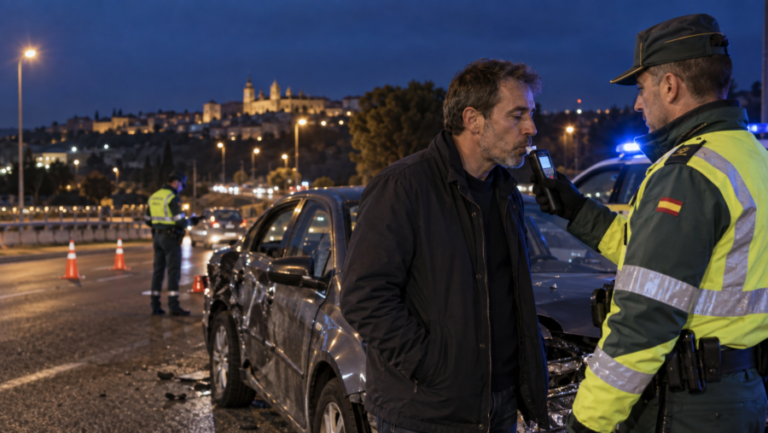
The police will normally carry out an initial screening test. If the result is positive, the driver will undergo evidential testing using an approved breathalyser.
Spanish procedure provides for two evidential breath tests, with at least ten minutes between them. The driver must also be informed of the right to request a contrast test, normally involving blood, urine or another appropriate medical sample. If the contrast test confirms the positive result, its cost may be charged to the driver.
The readings, the breathalyser’s verification documentation and compliance with the testing procedure can all be relevant when assessing a case.
Refusing to take a legally required alcohol test is not a safe alternative. Refusal may itself constitute a separate criminal offence with serious penalties.
What changes if the driver is not resident in Spain?
When an alleged offender cannot prove legal residence in Spain, the police officer may provisionally determine the amount of the fine. If the driver does not pay or deposit that amount, the vehicle may be immobilised.
This rule is designed to ensure that a traffic penalty can still be enforced after a visitor leaves Spain. It does not mean that every non-resident must always pay in cash at the roadside. The available payment method depends on the authority managing the sanction.
Paying a reduced fine promptly may be treated as acceptance of liability and can affect the right to challenge the penalty. A driver who believes that the reading, procedure or identification is incorrect should obtain advice before making a decision.
Can Spain deduct points from a foreign driving licence?
The practical position depends on the licence and the driver’s status.
If you hold a Spanish driving licence, the applicable points will normally be deducted from your Spanish driving record.
If your licence was issued abroad, a Spanish points deduction does not automatically alter the points recorded by the issuing country. However, that does not prevent the Spanish authorities or courts from restricting your right to drive in Spain.
Information about serious road traffic offences may also be communicated between European authorities through cross-border enforcement mechanisms.
Do foreign residents have to exchange their driving licence?
It is incorrect to say that every foreign resident must automatically exchange their licence for a Spanish one.
Licences issued by EU and EEA countries generally remain valid in Spain, subject to the applicable European and Spanish rules. Registration or exchange may be required in particular situations, including expiry, loss, certain validity periods or when the holder becomes subject to specific Spanish administrative requirements.
For non-EU licences, the position depends on how long the holder has been resident in Spain and whether Spain has an exchange agreement with the country that issued the licence. Many non-EU licences cease to be valid for driving in Spain after the initial period of residence unless they can be exchanged.
Because the rules vary by country and licence type, the driver’s exact documentation should be reviewed rather than relying on a general rule.
Can a foreign driver be banned from driving in Spain?
Yes. A Spanish court or traffic authority can prohibit a foreign licence holder from driving within Spanish territory.
The fact that the physical licence was issued by another country does not make the driver immune from a Spanish ban. Spain does not necessarily have the power to cancel the person’s entitlement to drive in every other country, but it can enforce the prohibition within Spain.
Driving in Spain while disqualified can create a further and potentially serious criminal problem.
What should you do if you are stopped for drink-driving?
Remain calm and cooperate with lawful instructions. Make a note of the time of each test, the readings shown, any information given about your rights and whether you requested a contrast test.
Do not assume that paying the fine, signing a document or returning home will bring the matter to an end. Administrative and criminal procedures have short deadlines, and a rapid criminal hearing may be arranged in serious cases.
Obtain legal advice promptly, particularly if:
The reading was close to the criminal threshold;
An accident occurred;
The police recorded signs of impairment;
You were asked to attend a fast-track criminal hearing;
Your licence was issued outside Spain; or
You depend on driving for work or residence purposes.
This article provides general information and does not constitute legal advice. The outcome of any case depends on its specific facts and on the law in force when the incident occurred. Information checked on 22 September 2026.
Official sources