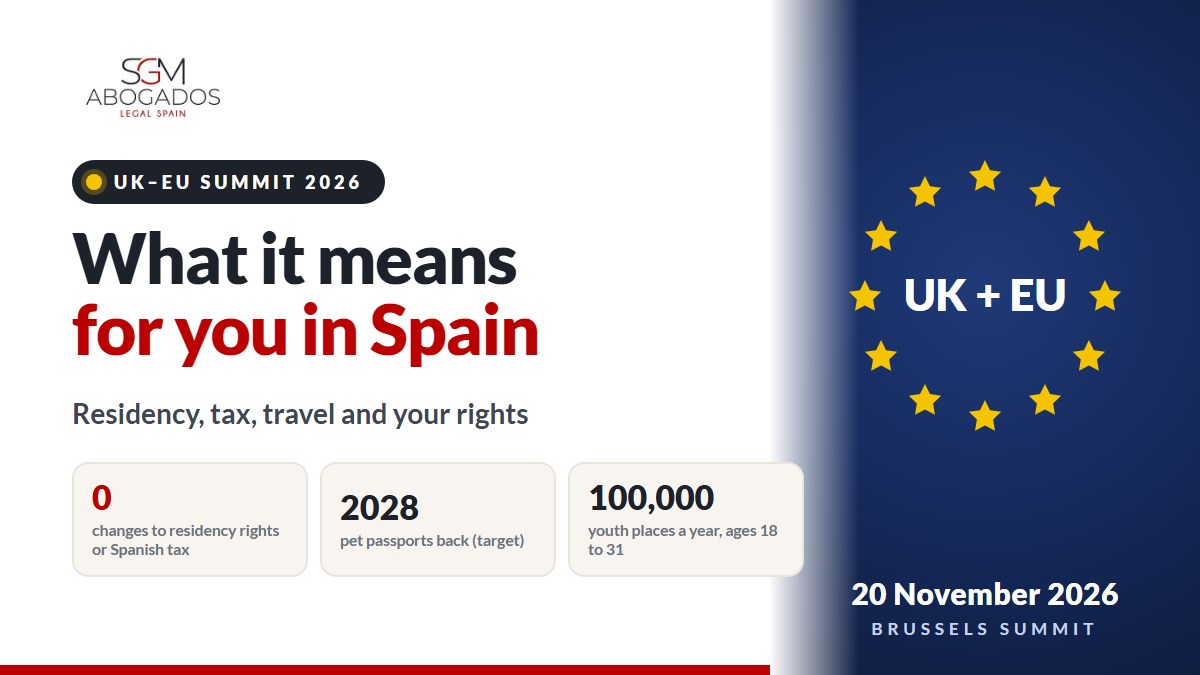
UK-EU Summit 2026: What It Means for Your Residency, Tax and Rights in Spain
UK–EU Summit 2026: What Changes for Your Residency, Tax and Rights in Spain
On 20 November, the UK and the EU closed deals on food trade, carbon pricing and a youth mobility scheme, and gave themselves six months to settle student fees. We've read the joint statement line by line. Here's what it means in law for British nationals who live in Spain, own property here or are planning the move, and what it leaves exactly as it was.
In brief
- The second UK–EU summit concluded negotiations on three agreements: food and plant health (SPS), a link between the two carbon markets and a Youth Experience Scheme for 18 to 31-year-olds.
- None of them is in force yet. They still need formal approval in the EU and the UK, and the target dates run from 2028 (food deal, pet passports, carbon link) to January 2030 (youth scheme).
- If you live in Spain under the Withdrawal Agreement, your rights are unchanged. Both sides recommitted to them "now and in the future".
- Nothing agreed touches Spanish tax. UK residents remain non-EU for non-resident income tax, and the UK–Spain double tax treaty is unchanged.
- The 90/180-day rule and the visa routes for moving here are unchanged. Buying a home still doesn't give you residency.
European Council President António Costa, Commission President Ursula von der Leyen and Prime Minister Andy Burnham met in Brussels on Friday 20 November for the second UK–EU summit. The first, in London in May 2025, set the agenda; this one turned much of it into concluded negotiations. The UK government is clear that it isn't a return to the single market, the customs union or free movement.
Since Friday, clients have been asking us the same questions: does this change my residency, my taxes or how long I can stay? The legal answer is no. The changes that are coming are narrower, later and more conditional than the headlines suggest. Here is the detail.
What was agreed at the UK–EU summit, at a glance
Tap a filter to see what was agreed, what is still being negotiated, and what the summit left alone.
- Deal concluded
Food, plants and animals (SPS)
Most certificates and border checks on agri-food goods between Great Britain and the EU go, in return for the UK following EU food rules as they change. Pet owners get a multi-use pet passport.
Target: 1 March 2028
- Deal concluded
Carbon markets linked (ETS)
UK and EU carbon permits become interchangeable, and each side's goods are exempt from the other's carbon border tax. The UK says about £6.5bn of exports are spared.
Target: 1 January 2028
- Deal concluded
Youth Experience Scheme
A capped visa route for 18 to 31-year-olds to live in the other side's territory for up to three years, to work, study, volunteer, au pair or travel.
First travel: by January 2030
- Under way
Erasmus+
The UK rejoins the EU's study and exchange programme. The first funding call opened on 18 November 2026.
From 2027
- Signed
Gibraltar agreement
The EU–UK agreement on Gibraltar has been signed and is being applied provisionally, pending its formal conclusion.
Applying provisionally now
- Agreed
Security, justice and migration
UK participation in EU civilian missions, closer police and judicial cooperation, and a new structured dialogue on migration and Channel crossings.
Ongoing
- Still negotiating
University tuition fees
A supplementing agreement on fees for EU students in the UK and UK students in the EU, whatever their immigration route. The EU wants it settled before the other deals take effect.
Deadline: about May 2027
- Still negotiating
Electricity market
The UK joining the EU's internal electricity market, linked to a UK financial contribution to EU regional funds.
Talks to end: 2027
- Still negotiating
Professional qualifications
"Significant progress" on recognising architects' qualifications, and a promise to explore other professions. Nothing yet for lawyers, doctors, teachers or trades.
No date
- Still negotiating
Business visitors
Talks on short business trips and sponsored stays continue "with a view to possible improvements". No change for now.
No date
- Not changed
Withdrawal Agreement residency
Rights of UK nationals who were living in Spain before 2021 stay as they are, and both sides pledged to protect them.
- Not changed
The 90/180-day rule and visas
Up to 90 days in any 180 without a visa. Longer stays still need a visa or residence permit; the routes are the same.
- Not changed
Spanish tax
Non-resident income tax, transfer tax, IBI, plusvalía and inheritance and gift tax all work exactly as before.
- Not changed
Healthcare and pensions
S1 healthcare, Spanish public healthcare for residents and your UK State Pension, including its yearly increases, are untouched.
- Not changed
Border checks (EES and ETIAS)
Not discussed. EES has applied in full since April 2026, and ETIAS is still to come.
- Not changed
Driving licences
Not on the agenda. The existing rules for residents exchanging a UK licence for a Spanish one carry on.
"Deal concluded" means the negotiators have finished. The texts still need formal approval in the EU and in the UK Parliament (the UK plans a European Partnership Bill), and the EU wants the three main deals to enter into force together.
Your residency rights: unchanged
If you were living in Spain before 1 January 2021 and hold a TIE (the residence card for Withdrawal Agreement beneficiaries), the summit changes nothing about your status. Both sides recommitted to implementing the Withdrawal Agreement in full. The joint statement says:
"We will ensure that all citizens are able to fully enjoy their rights, now and in the future." EU–UK joint statement, 20 November 2026
- Your residence card: unaffected. Keep your TIE in date and start the renewal in good time; an expired card causes problems at the border and with banks.
- Border checks: Withdrawal Agreement residents are outside the EES as short-stay visitors and won't need ETIAS. Show your TIE with your passport every time you travel.
- Healthcare and pensions: S1 cover, Spanish public healthcare and your UK State Pension, with its yearly increases, carry on as now.
- Family members: the Withdrawal Agreement rules on family members joining you are unchanged. For adult children and grandchildren under 31, the youth scheme (below) adds a separate route from 2030.
If you moved here after 2020 on a visa, such as the non-lucrative visa or the digital nomad visa, nothing changes either: you renew on the same terms and conditions as before.
Tax: nothing in the summit changes what you pay
Tax wasn't part of any agreement. The UK remains outside the EU for Spanish tax purposes, so UK-resident owners keep paying non-resident income tax at the non-EU rates, and the UK–Spain double tax treaty still decides which country taxes which income.
| Spanish non-resident income tax | If you live in the UK | If you live in the EU/EEA |
|---|---|---|
| Rental income | 24% of the gross rent, no expenses deducted | 19% of the rent after allowable expenses |
| Home you don't let (imputed income) | 24% on 1.1% or 2% of the cadastral value, every year | 19% on the same base |
| Gain when you sell | 19% of the gain, with 3% of the price withheld by the buyer | The same |
Two related points. The Spanish government's proposed 100% tax on homes bought by non-EU, non-resident buyers, first announced in January 2025, has not become law and wasn't discussed at the summit. And the tax changes that are coming for property owners come from Spain's own housing decree, not from Brussels, including 10% VAT on holiday lets from 1 December. Our guide to the housing decree explains them.
If you become tax resident in Spain (broadly, more than 183 days a year here, or your main interests here), you are taxed on your worldwide income and must declare your overseas accounts, investments or property on the Modelo 720 if any of those categories passes €50,000. Nothing at the summit changes that either.
Moving to Spain: the legal routes are the same
For anyone planning to move here, the summit opens no new route except the youth scheme for 18 to 31-year-olds. For everyone else, the position is as it was last week:
- As a visitor you can stay up to 90 days in any 180. Owning a home here doesn't extend that.
- The golden visa has gone. Spain closed it in April 2025, so buying property no longer gives a right to reside.
- The main routes are the non-lucrative visa (for people with passive income who won't work here), the digital nomad visa (for remote workers), and work or self-employment authorisations.
- Timing matters for tax. The date you become resident affects which country taxes your income that year and how pensions, lump sums and gains are treated.
Plan the visa before the purchase. If you are buying a home with a view to living here, choose your residence route first: it decides what documents, income and health insurance you'll need, and when your tax residence starts. Our guide to timing your move to Spain explains why, and our buying guide covers the purchase itself.
Travel, border checks and pets
The 90/180-day rule, EES and ETIAS
Visitors with a UK passport can still spend up to 90 days in any 180 in the Schengen area. The EU's Entry/Exit System (EES) now records fingerprints and a photo at the first crossing and counts days automatically, so an overstay is recorded and can affect future entry.
ETIAS, the online travel authorisation, hasn't started. The EU now expects it in 2027 and says it will give several months' notice. It will cost €20, last three years, and be free for under-18s and over-70s. Residents with a TIE won't need it. Ignore any website offering to sell you one now.
Pets: one passport instead of a certificate per trip
Today, a dog, cat or ferret travelling from Great Britain to Spain needs a new animal health certificate for every trip. Under the SPS deal, owners will be able to get a multi-use pet passport instead, once the agreement applies; the target is 1 March 2028, and the UK government will publish details on applying in 2027. If your pet lives with you in Spain, a Spanish vet can usually issue an EU pet passport already, which Great Britain accepts. The UK is also tightening its own rules on importing puppies and kittens under six months old.
Under-31s, students and professionals
The Youth Experience Scheme is the closest thing to free movement since Brexit, but it is a capped visa route with conditions:
| Youth Experience Scheme | What's been agreed |
|---|---|
| Who | UK citizens aged 18 to 31 when their visa starts (and EU citizens going the other way) |
| How many | Up to 100,000 a year each way, shared out between EU countries by population |
| How long | Up to 3 years: a 2-year permit plus an optional third year. You can move country up to twice, after 12 months in each |
| What you can do | Work, study, au pair, volunteer or simply travel. Countries can limit work, but most say they won't |
| Conditions | An application fee (not yet set), proof of funds, full health insurance, no dependants, no benefits |
| When | First young people travelling no later than January 2030 |
Students: the UK rejoins Erasmus+ in 2027. Tuition fees are still being negotiated: EU students in the UK currently pay international fees, often around three times the home rate, and both sides say they'll strike a deal within six months covering every student from the other side, whatever their visa. If a child is choosing a university for 2027 or 2028, wait for the outcome.
Professionals: apart from architects, where talks are well advanced, there is still no deal on recognising UK qualifications. To practise a regulated profession in Spain, you still need the Spanish recognition (homologación or reconocimiento) of your qualification.
UK–EU summit: the key dates
- Done19 May 2025
First UK–EU summit in London sets the agenda.
- Done10 Apr 2026
EES fully running at every Schengen border. Passport stamps end.
- Summit20 Nov 2026
Second summit in Brussels concludes talks on the SPS, ETS and youth deals.
- 20272027
UK back in Erasmus+. ETIAS expected to start, date to be announced.
- DeadlineMay 2027
Six-month deadline for the tuition fees agreement.
- TargetBy end of 2027
Talks on the UK joining the EU electricity market due to finish.
- Target1 Jan 2028
UK and EU carbon markets linked.
- Target1 Mar 2028
Food deal applies. Multi-use pet passports replace one-trip health certificates.
- TargetBy Jan 2030
First young people travel under the Youth Experience Scheme.
A legal caution on those dates: the three main agreements are designed to enter into force together, and EU diplomats have said they want the fees deal first. Until each text is formally concluded and in force, none of it gives anyone enforceable rights.
Myth or fact?
Tap a card to see the answer.
1 of 6"Free movement is back."Reveal
The only new route is the capped youth scheme for 18 to 31-year-olds, from 2030 at the latest. Everyone else still needs a visa to stay more than 90 days.
2 of 6"I need to renew or change my TIE because of the summit."Reveal
Nothing in the summit affects your residence card. Renew it on its normal schedule.
3 of 6"UK owners will now pay the EU rate of non-resident tax."Reveal
Tax wasn't on the agenda. UK residents still pay 24% on gross rent, against 19% after expenses for EU residents.
4 of 6"The new deals already apply."Reveal
Negotiations are concluded, but the agreements still need formal approval on both sides. The targets are 2028 to 2030.
5 of 6"Pet passports are coming back."Reveal
A multi-use pet passport will replace the one-trip health certificate once the food deal applies, with a target of 1 March 2028.
6 of 6"My 25-year-old can come and work in Spain."Reveal
Under the youth scheme, yes, for up to three years, but places are capped and the first young people travel by January 2030.
Your legal checklist after the UK–EU summit
Pick the one that fits you best.
You live in Spain
- No action needed: your Withdrawal Agreement rights are unchanged.
- Check your TIE's expiry date and book the renewal early. Carry it with your passport whenever you travel.
- File your Spanish income tax return as usual, and the Modelo 720 if any category of overseas assets passes €50,000.
- Keep proof of your residence date: it matters for tax and for any future applications.
You own a property here but live in the UK
- Keep counting your days: 90 in any 180 still applies, and EES now counts them at the border.
- Keep filing your yearly non-resident tax return (Modelo 210), even if you don't let the property.
- If you let to holidaymakers, register and charge 10% VAT from 1 December 2026 under the housing decree.
- Travelling with a pet from the UK? You still need a health certificate for each trip until the pet passport arrives.
You're planning to move to Spain
- Choose your visa route first: non-lucrative, digital nomad, or a work or self-employment authorisation.
- Plan the date you become tax resident, especially if you're selling a UK home or taking a pension lump sum that year.
- Get your NIE early, and have documents apostilled and translated where needed.
- If you're under 31, compare a visa now with waiting for the youth scheme (by January 2030).
Wills and inheritance
- The summit doesn't change succession law: under EU rules, Spain applies the law of your habitual residence unless you choose your nationality's law in your will.
- A Spanish will covering your Spanish assets makes probate here much faster for your family.
- Review your will after any move, marriage, divorce, sale or purchase.
- Inheritance and gift tax depends on the region; check your heirs' position before you buy or gift.
You (or your children or grandchildren) are under 31
- Watch for the scheme opening, no later than January 2030. Fees and each country's terms are still to be published.
- You'll need to be 18 to 31 when the visa starts, with proof of funds and full health insurance.
- Places are capped and shared by population; expect demand for Spain to be high.
- Students: the UK is back in Erasmus+ from 2027, and a fees deal is due by about May 2027.
UK–EU summit: frequently asked questions
What was agreed at the UK–EU summit in November 2026?
On 20 November 2026 in Brussels, the EU and UK concluded negotiations on a food and plant health (SPS) agreement, a link between their emissions trading systems and a Youth Experience Scheme for 18 to 31-year-olds. They aim to apply the food deal from 1 March 2028 and the carbon link from 2028, with the youth scheme open by January 2030. They also agreed to settle student tuition fees within six months.
Does the summit affect my residency in Spain?
No. Both sides reaffirmed the Withdrawal Agreement and the rights it protects. If you hold a TIE, keep it in date and carry it when you travel. If you live here on a visa, renew on the usual terms.
Will UK owners pay less non-resident tax in Spain?
No. Tax wasn't part of the agreements. UK residents still pay 24% on gross rental income, against 19% after expenses for EU and EEA residents, and the UK–Spain double tax treaty is unchanged.
Can British people now stay in Spain for more than 90 days?
No. The 90/180-day rule is unchanged. To stay longer you need a visa or residence permit. From January 2030 at the latest, people aged 18 to 31 will have a new option, the Youth Experience Scheme.
Does buying a property in Spain give me residency?
No. Spain closed its golden visa in April 2025, and the summit didn't change that. You need a residence route such as the non-lucrative visa or the digital nomad visa.
When will pet passports return for trips from the UK?
When the food (SPS) agreement applies, with a target of 1 March 2028. Owners will be able to get a multi-use pet passport instead of an animal health certificate for each trip. Until then the current rules apply.
Do I need ETIAS to travel to Spain?
Not yet. ETIAS hasn't started, and the EU now expects it in 2027, with several months' notice. It will cost €20 and last three years. Spanish residents with a TIE won't need it.
SGM Abogados
Not sure where the summit leaves you?
Residency, visas, tax, wills or a property purchase: our lawyers will tell you plainly what applies to your situation and what, if anything, you need to do.



About Post Author