Pay to Drive – 3c Per Kilometer
Annual mileage checks for cars and pay-per-use: up to more than €450 in new taxes
The new vehicle usage fee that is already being considered in Spain and the European Union to offset the loss of revenue from hydrocarbon taxes and to finance roads already has stipulated rates: 3 cents per kilometer.
Sooner or later, we will pay for vehicle use . There seems to be no other solution in the European Union to address two serious problems facing society : first, the infrastructure investment deficit , which makes the upkeep and maintenance of roads unfeasible without charging for their use; and second, the loss of revenue experienced by all member states due to the rise of electric cars, which significantly reduces income from hydrocarbon taxes, a previously indispensable source of state funding.
Given this reality, all roads lead to the same solution: paying for vehicle use through a new tax levied based on mileage . The formula is clear, and it’s the same one used, for example, by public transport: the user pays.
Pay-per-use vehicles are getting closer.
What until now seemed little more than a mere notion or trial balloon is now gaining traction . It’s no longer just one or two, but several European Union member states that are considering this same road usage fee model , even setting potential rates that, interestingly, are practically identical . Everything seems to be in place for this new fee that all drivers will have to pay in the future.
Payments of 3 euro cents per kilometer traveled: more than €400 per year
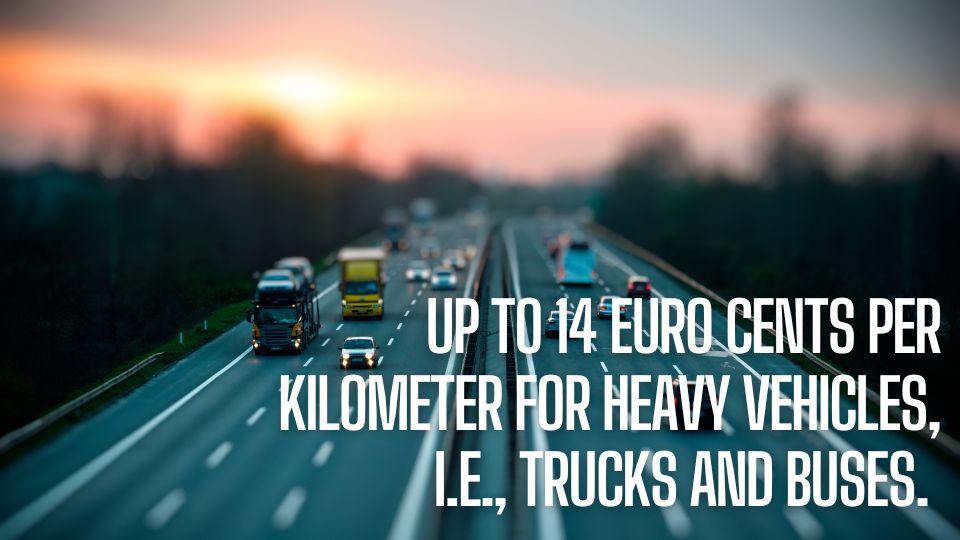
Seopan stated unequivocally: the need to finance infrastructure now requires a toll of 3 euro cents per kilometer for light vehicles, and up to 14 euro cents per kilometer for heavy vehicles, i.e., trucks and buses. This payment, for an average driver who, let’s say, travels 15,000 kilometers per year , would represent an additional cost of between 400 and 500 euros annually . According to this proposal, already submitted to the Spanish government, it would affect no less than 13,674 kilometers of Spanish highways and motorways, of which 74% are owned by the State and 26% by the autonomous communities.
Germany, for its part, is also already studying a distance-based toll for passenger vehicles as the best option to continue preserving and safely maintaining its infrastructure. For now, however, no specific rates have been announced. Meanwhile, other countries like Norway and the United Kingdom are also advocating for accelerating the implementation of tolls , but in their case, as we have anticipated, to offset the loss of revenue caused by the reduced use of fossil fuels . Until now, these fuels were heavily taxed, making them vital to the national budget due to their significant revenue. This toll would primarily apply to electric and plug-in hybrid vehicles , which are currently exempt from any taxation.
The most curious thing is that the British government has already included the plan in its draft state budget , calling it the new Electric Vehicle Excise Tax (eVED), with the target date set for it to come into effect in April 2028… precisely with a pricing system very similar to the one proposed in Spain by Seopan . According to the UK Treasury, the tax would be 3 pence per kilometer travelled, which at the current exchange rate would be about 3.4 euro cents .
Annual checks of car mileages to establish rates
Another important change would be how this mileage would be monitored in vehicles . While many plans have so far focused on road tolls , using license plate readers and gantries that don’t require cars to stop at traditional toll booths, the British Treasury is now considering another solution: annual monitoring of the actual distance traveled by each vehicle.
This mileage would be verified, for example, annually through mandatory vehicle inspections (ITV) , or, in the case of newly purchased cars, during the first and second anniversaries of their initial registration. This tax on electric vehicles would then be calculated along with other ordinary taxes and would have to be paid, for example, like the road tax we pay in Spain.